In my work across countries, institutions, and leadership environments, I have found that the most effective decisions are not the largest—but the most consistent.
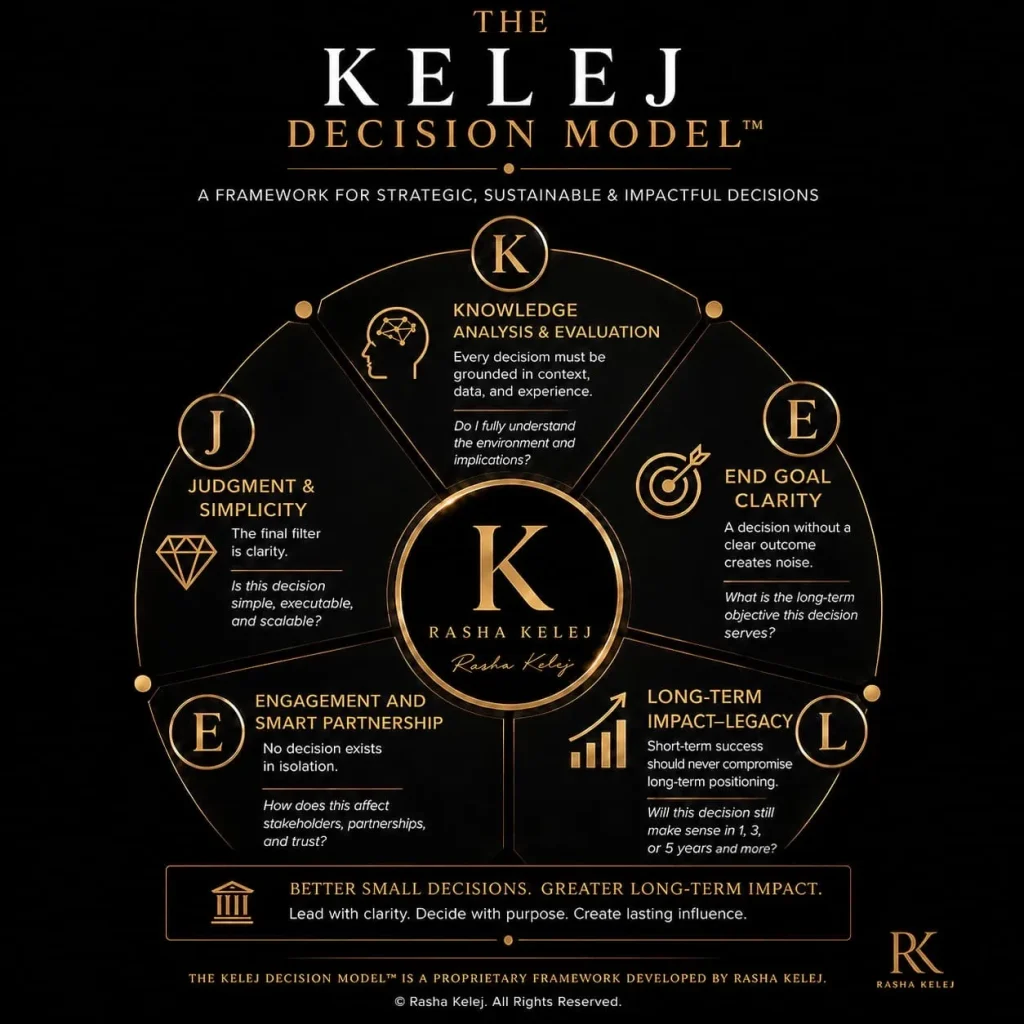
To ensure clarity, alignment, and long-term impact, I developed a structured approach to decision-making:
The KELEJ Decision Model™
A simple yet powerful framework designed to guide leaders through complex decisions with clarity, consistency, and strategic focus.
- Why influence, leadership, long-term success and Legacy can be built through consistent, small decisions.
We often associate success with big decisions—major investments, bold moves, or defining moments.
But in reality, the trajectory of individuals, organizations, and even nations is often shaped by something far less visible:
small , subtle decisions, made consistently over time.
These decisions rarely attract attention. They are not announced. They are not celebrated.
Yet, they accumulate—and eventually define outcomes.
(This fact represents my Decision Framework that I am using since 14 years . I will share my model with you at the end of this article ….. )
Strategic Direction is Built Daily
In leadership and business, strategy is not only defined in formal settings or board rooms.
It can be shaped through daily decisions:
- What to prioritize
- What to ignore
- Where to focus energy
A company that consistently chooses long-term value over short-term visibility builds resilience.
A leader who consistently chooses clarity and simplicity over complexity builds trust and most of times builds a Legacy.
The Compounding Effect
The real power of small decisions lies in their cumulative effect. Like going to the gym and exercise daily. We all know the end result ..right ?!
Individually, these small decisions may seem insignificant.
Collectively, they:
- Build momentum
- Strengthen positioning
- Reduce risk over time
- Lead to exponential growth.
Examples: When Small Decisions Changed Outcomes
Steve Jobs — 1997
Simplified Apple’s product line → restored clarity → enabled long-term success
Jeff Bezos — Early 2000s
Introduced the “empty chair” at Amazon → embedded customer obsession
Neil Armstrong — 1969
Manual landing decision during Apollo 11 Moon Landing → ensured mission success
Warren Buffett — Since 1960s
Consistently investing within his “circle of competence” → long-term dominance.
What these examples demonstrate is not just decision-making—but disciplined thinking.
The real question is:
How can this be applied consistently in leadership and operation and global work?
The Decision Framework I Use in Leadership
In my experience ; working across more than 50 countries and their local institutions, and leadership environments, decision-making cannot rely on instinct alone.
It requires a structured framework that ensures consistency, clarity, and long-term impact and in our case leads to strong Legacy .
1. The Alignment Filter
Before making any decision, I ask:
- Does this align with long-term objectives?
- Does it reinforce credibility and trust?
- Will it still make sense beyond the immediate context?
If a decision only works in the short term, it is rarely the right one. However sometimes it is strategic to have some short term decisions that is necessary to mitigate risk or motivate yourself , your team and partner , knowing that accumulating them should lead to your end goal. It is a balance that requires management talent , skill and experience.
2. The Simplicity Principle
Complex decisions often create execution challenges and distraction.
I mainly focus on:
- Clear direction
- Clear communication
- Clear outcomes
If a decision cannot be explained simply, it will not scale effectively. However sometimes issues are complicated and require multi faceted approach that requires my attention . This should not be often.
3. The Consistency Rule
A single strong decision is not often enough.
The question is:
- Can this decision be repeated consistently?
Consistency builds:
- Reputation
- Trust
- Influence
4. The Relationship Impact Check
Every decision influences relationships.
I consider:
- Does this decision strengthen long-term partnerships?
- Does it create unnecessary friction?
- Does it respect context and stakeholders?
Influence is built through relationships—not isolated actions.
5. The Long-Term Visibility Lens
Some decisions bring immediate visibility.
Others build lasting impact. Honestly , we need both in balance.
However I always prioritize:
- Sustainable outcomes
- Scalable initiatives
- Long-term positioning
However: I also have to capitalize on small successes and quick winning to motivate myself , my team and my partners. This approach needs talent and experience to create this balance and deal with this paradigm .
Practical Application for Leaders
This framework is not theoretical—it can be applied immediately.
In Operation :
When making strategic decisions:
- Prioritize long-term value over quick wins but capitalize on both.
- Simplify execution to ensure consistency and real impact not only intentions.
- Align every initiative with a clear objective that add mutual value to motivate your collaborators.
In Leadership
When managing teams or partnerships:
- Be consistent in standards and communication.
- Reinforce trust through predictable actions
- Focus on relationships and adding mutual value.
In Global or Institutional Work
When operating across different countries and cultures :
- Maintain neutrality and clarity
- Respect different perspectives, contexts and cultures.
- Build institutional systems that can scale beyond individuals
Therefore ; The leaders who succeed are not necessary those who make the biggest decisions.
They are those who make the right small decisions—consistently, over time.
Understanding the power of small decisions changes how I lead, how I build, and how I think about impact and legacy.
Because ultimately; Influence is not created in a moment and Success is not defined by one action, It is built through disciplined, consistent decisions—made every single day.
To ensure clarity and alignment and create long-term impact and legacy , I developed a structured approach to my decision-making process :
The KELEJ Decision Model™
A simple yet powerful framework designed to guide leaders through complex decisions with clarity, consistency, and strategic focus.
As promised I am sharing my signature decision model which I will explain further in my next article. Stay tuned……….

Senator Dr. Rasha Kelej
CEO of Merck Foundation.